
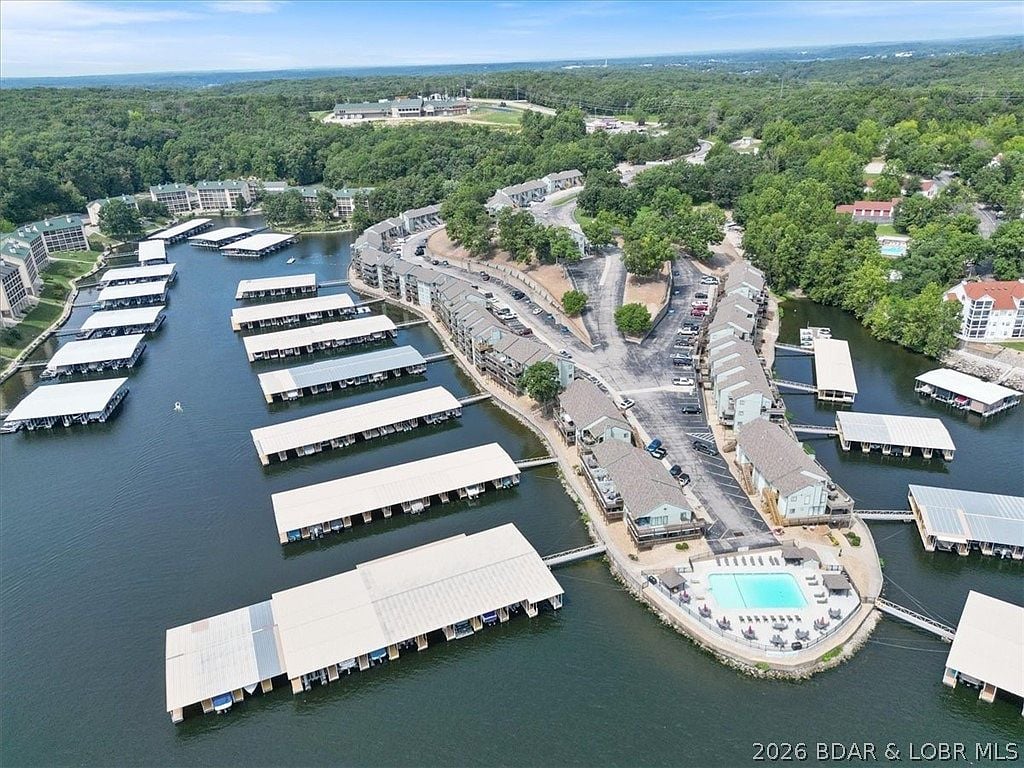
Buying a Condo With a Boat Slip at Lake of the Ozarks: What to Verify Before Closing
Buying a condo at Lake of the Ozarks doesn't automatically mean you own a boat slip. A slip might be deeded separately, tied to the unit, assigned by the association, or leased, and each arrangement comes with different rights, costs and transfer rules. Before you close, verify four things for the specific unit: the legal arrangement, whether the slip fits your boat, what it costs, and what has to happen for the rights to pass to you.
How slip arrangements can work
These categories are illustrative. The actual rights depend on the property's documents, and only a review of those documents, with local legal advice where needed, can tell you what you're buying.
- Separately deeded slip. The slip is its own piece of property with its own recorded deed. It may be sold with the condo or separately.
- Rights attached to the condo. The declaration or recorded documents tie a specific slip, or a right to use one, to a specific unit.
- Association assignment or license. The association controls the slips and assigns them under its rules. An assignment may be personal to the current owner, may need approval to transfer, or may be revocable.
- Lease or rental agreement. The slip is rented, from the association or a third party, for a set term. It may end, renew, or have a waiting list.
The practical difference: with some arrangements the slip moves with the deed; with others, the seller's slip ends when the seller leaves.
Advertised, available, assigned or included?
These four phrases describe different situations:
- Advertised means a listing or brochure mentions a slip. That's a marketing statement, not proof of rights.
- Available to rent means the complex may have slips you can apply for, possibly with a waiting list.
- Assigned to the seller means the seller uses a slip today. That doesn't mean it transfers to you.
- Included in the sale means the purchase agreement and supporting documents show the slip, or the right to it, passing to you.
Only the last one tells you what you're buying, and it should be in writing.
Documents to request
Ask for whichever of these apply. Each helps answer a different question.
- Recorded documents (deeds, plats, easements): whether a slip or slip right is recorded and with which unit.
- Condominium declaration: how slips are defined and whether they're common elements, limited common elements, or separate units.
- Association rules and bylaws: assignment, transfer, guest use, rental, boat restrictions and modifications.
- Slip assignment, license or lease: who holds it, the term, renewal, and whether it can be transferred.
- Fee schedule: dues, rent, electricity and other recurring charges.
- Transfer requirements: forms, approvals and any transfer fee.
- The purchase agreement: exactly what's included, including slip, lift and equipment.
Your agent can help gather these, and a title professional or real estate attorney can help interpret recorded documents.
Does the slip right transfer to you?
Don't assume the seller's arrangement continues. Ask:
- Does the right transfer automatically with the deed?
- Does it require association or lessor approval, and how long does approval take?
- Does it expire, renew, or need to be reapplied for?
- Can the association reassign slips?
- If there's a waiting list, where would you be on it, and is that in writing?
Get answers early enough to act within your contract's deadlines, not on closing day.
Matching the slip to your boat
A slip that's technically yours isn't useful if your boat doesn't fit. Advertised dimensions are a starting point, not a measurement.
Check:
- Usable width and length of the slip, measured, not taken from a listing.
- Your boat's beam and overall length, including swim platforms, outboards and anything that extends past the hull.
- Lift compatibility and capacity for your boat's weight and hull type.
- Clearance under any roof or structure.
- Access from the condo to the dock: distance, stairs, slope, gates.
- Water depth. Lake levels change. Ameren Missouri's license allows normal fluctuations down to 654 feet, with an annual drawdown period from February 1 to April 1 (Ameren Developer Information). Ask whether the slip stays usable for your boat at lower water.
If you're unsure, have the slip and lift checked against your boat's specifications by a qualified dock or lift professional.
The slip isn't the lift
A slip is space. A boat lift, PWC port or other equipment is separate property, and it may or may not be included. For each item, verify:
- Who owns it: the seller, the association, or someone else.
- Whether it's included in the sale, in writing.
- Its condition and capacity.
- Who maintains it after closing.
- Whether a separate bill of sale or transfer document is needed.
Costs to confirm
Not every complex charges each of these, and amounts vary. Ask about:
- Recurring: slip rent, association or dock dues, electricity, insurance requirements, maintenance.
- Occasional: special assessments for dock repair or replacement.
- One-time: transfer or assignment fees.
Get the current fee schedule and ask whether any dock assessments are planned or under discussion.
Rules that affect how you use the slip
Rules differ by complex and agreement. Ask about:
- Guest use of your slip.
- Renting or subleasing the slip to others.
- Boat type, size or age restrictions.
- Adding or changing a lift or other equipment.
- Insurance you're required to carry.
- Who's responsible for damage to the dock, other boats, or your boat.
Dock, lift and electrical concerns
If anything about the dock, the lift or the dock's electrical system looks wrong, get a qualified professional to assess it. Ameren notes that dock electrical systems must meet local, state and national standards (Ameren Developer Information). Ask the association about the dock's maintenance history and any known issues.
Who can help confirm what
- Your agent: gathers documents, coordinates questions, and tracks contract deadlines.
- Title professional: recorded interests. Ask specifically whether a separate slip interest is covered; title insurance doesn't automatically cover it.
- Association or lessor: current assignments, transfer rules, approvals, fees and waiting lists.
- Lender: whether condo financing involves the slip. A condo loan doesn't automatically include a separate slip interest.
- Insurer: coverage for the slip, lift and boat, and any association requirements.
- Real estate attorney: interpreting documents and rights when anything is unclear.
Verification table
What to verify | Evidence to request | Who can confirm it |
|---|---|---|
Type of slip arrangement | Deed, declaration, assignment, license or lease | Title professional, attorney, association |
Slip is included in the sale | Purchase agreement language | Your agent |
Rights transfer to you | Transfer rules, approval letter | Association or lessor |
Term and renewal | Lease or license terms | Association or lessor |
Waiting-list position | Written confirmation | Association or lessor |
Slip fits your boat | Measurements, boat specs | Dock or lift professional |
Lift ownership and inclusion | Bill of sale, purchase agreement | Your agent, seller |
Lift condition and capacity | Service records, assessment | Lift service company |
Current and planned costs | Fee schedule, budget, meeting minutes | Association |
Usage rules | Rules, bylaws | Association |
Insurance requirements | Association rules, insurer quote | Association, insurer |
Warning signs
None of these means a deal is bad, but each is worth resolving before you're committed:
- The slip is promised verbally but isn't in the purchase agreement.
- Nobody can explain whether the assignment transfers.
- Documents are missing or "on the way."
- A waiting-list spot is mentioned but not confirmed in writing.
- Slip dimensions haven't been measured against your boat.
Before closing
- Slip, lift and equipment inclusion is written into the purchase agreement.
- Slip rights are documented, and you understand the arrangement type.
- Any required association or lessor approvals are obtained.
- Recurring and one-time costs are confirmed.
- Physical fit is checked against your boat.
- Equipment ownership, condition and transfer documents are in order.
- Any unresolved conditions are addressed within contract deadlines.
Find a condo that fits your boat
Slip arrangements vary from one complex to the next, and availability changes. If you're looking for a Lake of the Ozarks condo with boating access, talk with a Matt Smith Real Estate Group agent about options that fit your boat and how you want to own it, and about verifying the details before you commit.